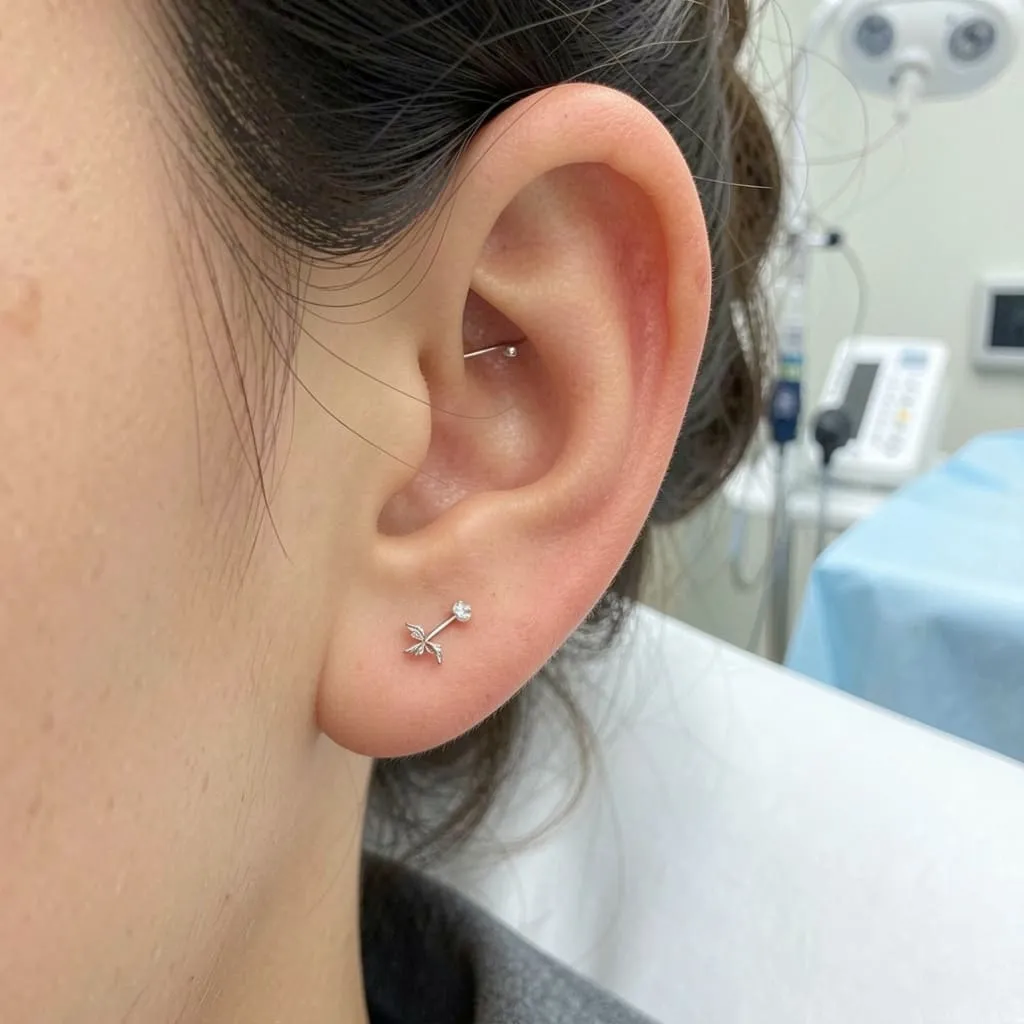
 Ear Piercing
Your visit, end to end
-
01
Welcome & quick consult
~5 minutesYour senior therapist reviews your notes, checks contraindications and confirms the plan.
-
02
Treatment
10 minutesThe protocol is delivered start-to-finish, calibrated in real time to how your skin / body is responding.
-
03
Aftercare brief
~5 minutesYou leave with a written aftercare summary and a re-book recommendation if relevant.
At a glance
- Duration
- 20 minutes
- Price
- £30
- Category
- Ear Piercing
- Patch test
- Not required
- Suggested frequency
- once — with proper aftercare you keep the piercing for life
- Equipment
- sterile single-use cartridges, titanium and surgical-steel stud options
Who this treatment is for
Ear piercing suits anyone aged 7+ for a first piercing, with parental consent for under-16s.
- First-time piercings for children aged 7+ (with parent or guardian).
- Second, third and helix piercings for clients who want additional ear styling.
- Sensitive-skin clients — we use titanium studs which are nickel-free.
- Re-piercing of a closed-over previous piercing.
- Anyone who wants the piercing done properly with sterile single-use equipment rather than reusable instruments.
- Clients who have had bad piercing experiences elsewhere — we take time to explain everything before starting.
Why we recommend the Ear Piercing
We recommend the Ear Piercing because it is professional ear piercing with sterile single-use cartridges, surgical-grade studs and clear written aftercare. Most high-street piercing uses a "gun" with reusable parts which cannot be properly sterilised — we use single-use cartridges that are loaded fresh for each client and disposed of after the appointment.
The choice of initial stud matters more than most people realise. sterile single-use cartridges, titanium and surgical-steel stud options. Titanium is the gold standard for sensitive skin and first piercings; surgical steel works for those without sensitivity; 14k+ gold is fine but watch for cheap "gold-plated" alternatives that contain nickel and cause reactions.
How the Ear Piercing works
A piercing creates a tract through the earlobe or cartilage which needs to heal cleanly around the stud. The initial healing forms a layer of new skin around the tract; full healing means that layer has thickened and stabilised enough that the piercing will not collapse if the stud is removed.
Healing times: 6-8 weeks for a standard earlobe; 4-6 months for cartilage. Keep the original stud in for the full healing window. clean healing with the right initial stud and proper aftercare.
The treatment protocol
Your piercing appointment:
- Consultation — we discuss placement, stud choice, and review aftercare so you know exactly what to expect.
- Mark — a sterile marker pen indicates the entry point. We check position in a mirror with you before piercing.
- Clean — both ears are cleansed thoroughly with an antiseptic.
- Pierce — single-use sterile cartridge, one ear at a time. The puncture itself takes a fraction of a second.
- Aftercare brief — written aftercare card given to you, with cleaning solution included.
- Optional check-in — free 4-week check-in if you have any concerns about healing.
In the room: what you'll experience
The piercing itself is fast — a sharp pinch then it is done. Some clients feel mild dizziness; we will sit you down with water if so. The ear will be slightly red and warm for a few hours, and tender to touch for 2-3 days.
Sleeping on the pierced side is uncomfortable for the first week — change pillowcases regularly and try to sleep on your back. We will explain all of this before you leave with written aftercare.
Results timeline
Healing follows this timeline:
- First 48 hours — warmth, redness, mild swelling. Tender to touch. Normal.
- Week 1-2 — settling. Some discharge (clear or pale yellow) is normal as the skin heals.
- Week 4-6 — outer healing complete for the earlobe. Inner tract still healing.
- Week 6-8 (earlobe) / 4-6 months (cartilage) — full healing. Stud can be safely changed.
- After full healing — change to any well-fitted earring. The piercing is permanent unless left out for an extended period.
Aftercare
Aftercare is the most important part. Six rules:
- Clean both sides of each piercing twice daily with the saline solution provided — for the full healing period.
- Do not rotate or twist the stud — old advice. Rotation tears healing tissue.
- Avoid swimming pools, hot tubs, lakes and the sea for the first 4 weeks.
- Keep hair products, perfume and makeup away from the piercing.
- Change pillowcases regularly and try to sleep on your back for the first 2 weeks.
- Do not change the stud before 6 weeks (lobe) / 4 months (cartilage). Even if it looks healed, the inner tract may not be.
Safety, contraindications and patch testing
We do not pierce active acne or eczema in the area, recent skin injury, or clients with bleeding disorders without medical clearance. Under-16s require a parent or guardian present with ID. We will not pierce children under 7.
No patch test is needed for this treatment.
Questions about this treatment
Anything we have not covered? Call 020 8374 3333 or email and we will get back to you the same day.
How long until I can change the earring? +
Will the Ear Piercing hurt? +
What metal should I choose for my first piercing? +
Do you pierce children? +
What if it gets infected? +
Can I pierce both ears at once? +
How do I know when it is healed? +
Can I sleep on the piercing? +
Other treatments to consider
Ready to book your Ear Piercing?
Slots release at 8am daily. Pick a time that suits you — we will confirm by email and text.